
Volatility and Risk: Comparing Cryptocurrency Behavior With High-Uncertainty Digital Activities
The Bank for International Settlements has reported that cryptocurrency markets can experience large price swings within short periods, creating conditions where uncertainty becomes a defining feature of user behavior and market participation. These fluctuations have attracted attention from economists, financial researchers, and technology analysts because they reveal how people react when outcomes become difficult to predict.
People entering digital environments often search for information before participating in unfamiliar systems. Resources such as Didihub registration guide (panduan daftar Didihub) can serve as examples of informational sources users review while learning about account processes, platform requirements, and participation structures. Across many digital spaces, uncertainty frequently influences decisions long before a person takes action.
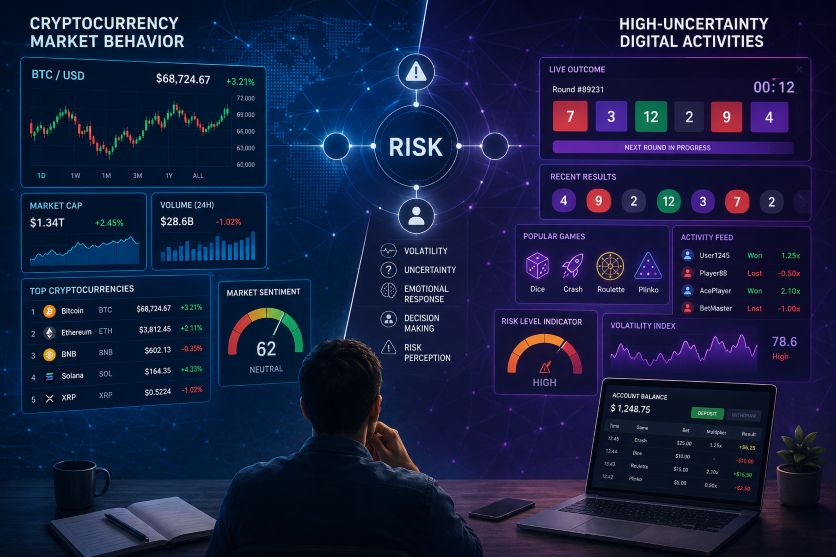
Understanding Uncertainty in Digital Environments
Uncertainty exists whenever future outcomes cannot be estimated with complete confidence. Financial markets have always contained elements of unpredictability, but digital technologies have increased the speed at which information moves and reactions occur. Cryptocurrency systems and other high-uncertainty digital activities provide useful examples because participants often make choices while dealing with rapidly changing conditions.
McKinsey & Company has discussed how digital ecosystems create environments where user decisions are shaped by fast-moving information and changing expectations. This does not automatically create irrational behavior. Instead, uncertainty often encourages people to process information differently, especially when timing and perceived opportunity become factors.
The discussion becomes more complex because uncertainty affects both financial and non-financial environments. Some users focus on market movements and asset values, while others interact with systems where outcomes depend on variables that cannot be fully controlled or predicted.
Thesis: Similarities Between Cryptocurrency and High-Uncertainty Platforms
At first glance, cryptocurrency markets and risk-based digital environments may appear unrelated. One involves digital assets and market valuation, while the other may involve systems centered on uncertain outcomes. However, several behavioral patterns overlap.
Rapid Feedback Cycles
Digital systems often provide immediate information. Cryptocurrency prices update continuously, and users can see changes in value within seconds. High-uncertainty platforms similarly provide fast feedback through changing conditions or outcome updates.
Quick responses can influence emotional reactions. People naturally pay attention when information changes rapidly because the brain interprets movement and variation as meaningful signals.
Emotional Responses to Fluctuation
The American Psychological Association has described how uncertainty can increase emotional responses and affect decision-making behavior. When people face rapidly changing environments, emotions sometimes influence choices as strongly as objective information.
This pattern appears across many digital systems. Participants may react to momentum, social discussion, or recent experiences rather than relying entirely on structured evaluation.
Social Influence and Community Dynamics
Communities frequently shape perception. Cryptocurrency discussions often spread through social media groups, forums, and online communities. Similar patterns appear across various uncertain digital environments where users share experiences and opinions.
Community discussion can amplify confidence or concern. Information sometimes moves faster than formal analysis, creating feedback loops where perception influences behavior.
Antithesis: Important Differences Between Cryptocurrency and Risk-Based Activities
Despite overlapping psychological patterns, meaningful distinctions exist.
Underlying Purpose
Cryptocurrency was originally introduced as a technology and financial system designed to facilitate decentralized transactions and digital ownership structures. Although market speculation exists, cryptocurrency infrastructure serves purposes beyond price movement.
Risk-based digital activities may function differently because participation often centers primarily around uncertain outcomes rather than broader technological utility.
Long-Term Utility Versus Immediate Outcomes
Some cryptocurrencies support payment systems, decentralized applications, or blockchain networks with practical functions.
Harvard Business Review has noted that blockchain technologies can have applications beyond trading activity, including record management and transaction verification systems.
Many high-uncertainty environments operate differently because participation may focus more heavily on short-term experiences rather than long-term technological value.
Regulatory Development
Regulatory approaches also differ significantly.
The International Monetary Fund has discussed the challenges governments face while developing frameworks for digital assets. Cryptocurrency regulations continue evolving globally because authorities attempt to balance innovation, financial stability, and consumer protection.
Other digital risk environments may operate under entirely separate legal structures depending on regional policies and definitions.
Synthesis: Financial Behavior Implications
Comparing these environments reveals interesting patterns in human decision-making. People often respond similarly to uncertainty even when systems serve different purposes.
One observable pattern involves attention allocation. Rapid changes tend to capture interest more effectively than stable conditions. Human psychology evolved to notice movement and unexpected events, and digital systems can intensify this response.
Another pattern involves perceived control. Individuals sometimes believe they understand systems more fully after repeated exposure, even when uncertainty remains unchanged. Researchers frequently examine this phenomenon because confidence and predictability do not always align.
Related terms associated with digital participation and behavioral spending patterns suggest that people sometimes make decisions using emotional shortcuts, particularly when environments become fast-paced and information-heavy.
This observation does not imply poor judgment or irrationality. Instead, it highlights how people process complex environments under uncertainty.
Long-Term Questions About Digital Risk Environments
Future developments may create additional questions for economists and researchers.
- How will users adapt to increasing digital complexity?
- Will education improve decision-making under uncertainty?
- Can transparency reduce misunderstanding in rapidly changing environments?
- How will regulation evolve across different digital systems?
These questions remain important because digital environments continue expanding into daily life.
Responsible Risk Warning: Activities involving financial uncertainty or gambling-related systems can involve potential financial and emotional risks. Participation should remain informed and balanced. Individuals should understand the possible consequences before engaging with activities involving uncertain outcomes.
READ ALSO: Digital Risk Culture Expands Through Trusted Australian Online Casinos
Conclusion
The comparison between cryptocurrency behavior and high-uncertainty digital activities reveals that technology often changes the environment while human responses remain surprisingly consistent. Fast information, emotional reactions, and social influence repeatedly appear across different systems. Although structures and purposes differ, behavioral spending patterns and uncertainty-driven decisions continue to shape how people interact with evolving digital ecosystems. Understanding these similarities and differences may help researchers and users better interpret future developments in digital participation.